Friday, 24 November 2023

A Rear Headlight for the Planet 2

 Because the Planet 2 (with Mini Train Systems electronics*) is operated by a tethered controller, it is quite practical to run the loco in reverse with the driving car coupled to the front of the loco, but there is no rear light.  

(* As I understand it, locos sold in the UK by Maxitrak have the controls inside the cab, so the driver need to be positioned to the rear of the loco and drive by reaching into the cab.)


To attach the rear light, I bent a strip of 20 x 1.6 mm aluminium to match the curve of the cab roof, and drilled 2 holes (4 mm dia.) so that it could be fixed in position using the rear fixing bolts for the cab roof.  This avoided the need to drill additional holes on the cab roof.  I then formed some brackets to suit the light mount, which is via an M5 bolt and nut (supplied).


I found the light on eBay, and it is a Chinese made headlight intended for electric bicycles.  The cost from an Australian suppliers was about $20.  The light operates over a wide range of voltage 6-60 V DC.  With some assistance from Mini Train Systems, I should be able to wire it in to the loco control unit so it can be controlled from the tethered controller.  For initial testing, I wired the cable supplied with the light to a 30/50A Anderson connector and plugged it into the battery charging terminals.


Wednesday, 22 November 2023

Revised Mainline Alignment

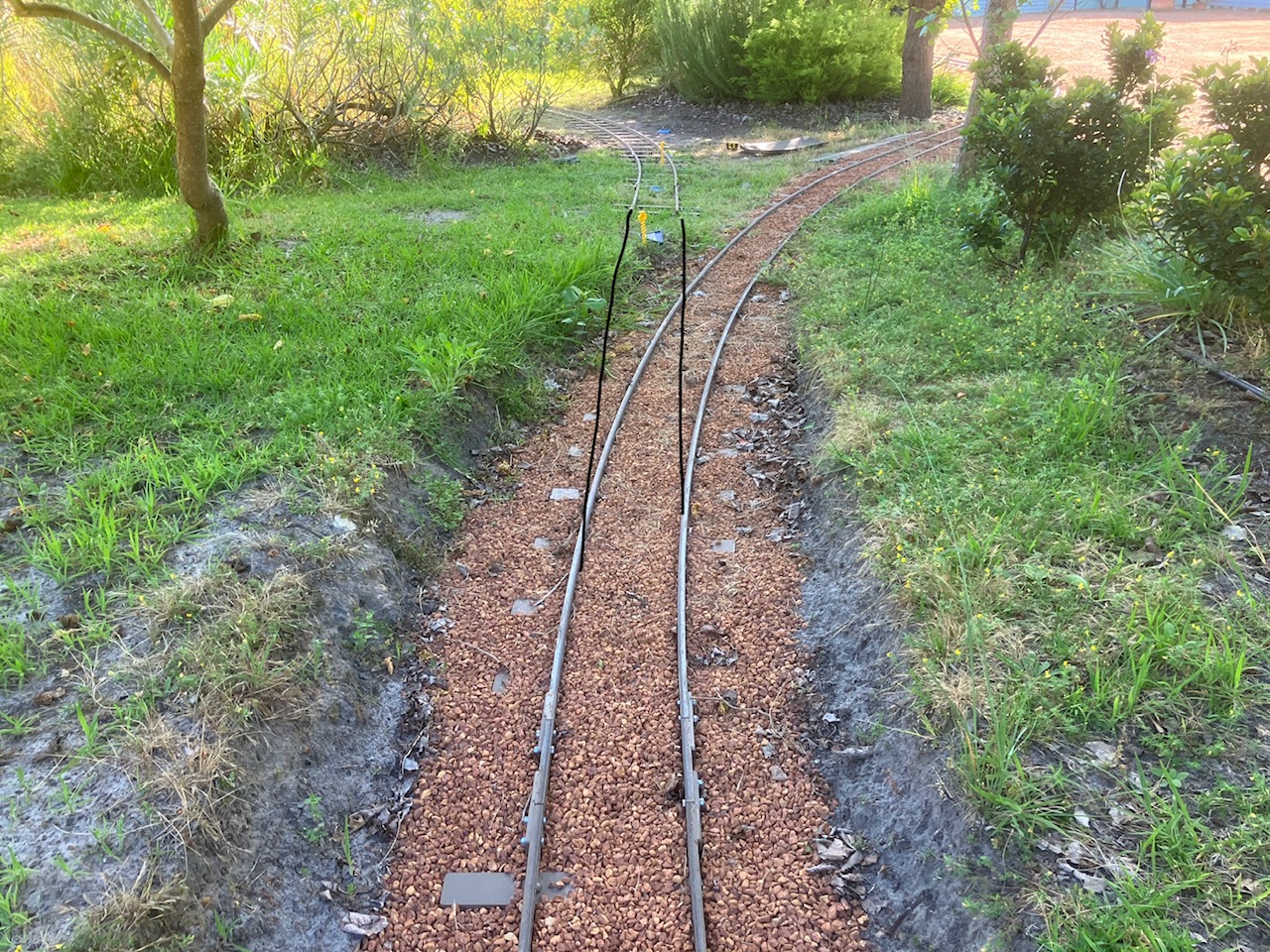
I set out some spare track pieces to test an idea for the next stage of trackwork.
A new point, currently on order, will branch off the current track, to form the start of the main line which will ultimately loop right around the garden. The existing track heading to the right will remain as a spur leading to the garage for train storage. Previously, the start of the main line was about 20 m closer to the garage.

Visible at the bottom of the photo below are the 170 mm long filler pieces supplied by Mini Train Systems to allow for future installation of a point in the middle of a curve, because a point is a bit longer than an equivalent 15° curve section. I originally installed the filler pieces in this location with a different plan in mind, so it is good luck that the new point will fit here.

After curving to the left, the new main line will punch through a gap to be cut in the hedge, passing by the gazebo in the background which will double as a station shelter.
The revised alignment will require about 20 m of additional straight track.  Fortunately, I was able to add this to the current order which is expected to be delivered during December 2023.  The length of the main loop will be unchanged, at about 300 m.

Below is the revised track plan:


Monday, 20 November 2023

Expanding the Wagon Fleet

 A new pair of bogies arrives from DNC!


I fitted the new bogies to the driving wagon, which now has the handbrake operating on both bogies.

For the first time, there are two bogie wagons operational.

I also fitted new bolsters to the ballast wagon so it could ride on bogies when required for ballasting duties.  The bogies from the utility flat wagon will be transferred to the ballast wagon when needed.

The wooden frame for the ballast wagon received a coat of paint as well.  Additional spacers can be added between the steel bolsters and wooden frame, if required, to fine tune the clearance between the discharge openings and the rail, which determines the quantity of ballast delivered.


Friday, 3 November 2023

A Utility Wagon

 As it seems delivery of gondola wagons from Mini Train Systems is still some way off, I had been thinking about building another interim wagon to use, especially as the pair of bogies I had ordered from DNC were due to arrive soon.

After figuring out a design in my head one afternoon, I started work and had the wagon built by the following afternoon.  The 2 m long timber frame is pine, left over from the pallets used for the track shipment.  As with the driving wagon, the bolsters are 50 x 50 steel from a spare fence post.  The floor is melamine coated chipboard from a former potting bench which we dismantled some time earlier.

Ready for its first test run.
After a coat of paint and some additional seating.
The wagon frame: mostly timber.


Thursday, 5 October 2023

End of Tracklaying for Now


Further tracklaying in progress beyond the lily pond through an area of fruit trees,

As the loco had arrived, for the first time, I was able to use the loco to haul ballast to the work site.  Here is the "work train" loaded with tools and equipment for tracklaying.  The ballast wagon is attached via an extra-long drawbar so that no additional weight is places on the track which is temporarily propped up to the correct height.
Having used up the initial 3 cu.m of ballast, a trip to the local landscaping supplier was needed for an additional trailer load.
This is the limit of tracklaying for now, as we have run out of straight track sections, with only a few curves left over.
A temporary buffer stop fixed to the rails with U-bolts marks the end of track for the time being.  Shortly afterwards, the buffer stop was upgraded with red reflectors and a central rubber bumper.


Friday, 22 September 2023

Maxitrak Planet 2 Locomotive Arrives!

A momentous day with the long-awaited delivery of the Planet locomotive.
 

It was very well packed in a wooden crate with foam packing on all sides.  The battery drill got a workout unscrewing numerous screws holding the crate together.


Finally, after freeing the loco from the crate, one end of the crate was used as a makeshift ramp to roll it down onto the track in the garage.


Mini Train Systems had separately shipped the plug-in speed controller, so it was a simple matter of plugging that into the rear of the cab, closing the main circuit breaker and away we go for the first test run.


Sunday, 10 September 2023

Across the Driveway and Beyond

The remaining track to the driveway, on a downgrade, was relatively plain sailing, compared to the cutting.


An advantage of working on the track in winter was that it was clear where water tended to accumulate necessitating drainage measures.  At both side of the driveway, 60 mm slotted drainage pipe was laid under the track and the trench filled with ballast and/or larger rocks to allow water to percolate through.


The next section of track from the driveway along the side of the lily pond was always going to be tricky, as the ground level dropped by 400 mm over a short distance.  Initially, I started using the soil removed from the cutting to build up an embankment to try to maintain the 1 in 50 maximum, but it soon became clear it was going to require a lot of dirt and, as the ground level continued to fall, the embankment might never reach natural ground level.

Plan B was to relay several track sections based on a steeper 1 in 33 gradient, and also dig a shallow cutting immediately past the driveway so the downgrade would commence earlier, to limit the length of the embankment.  

In the photo below, the track on the left is on the original embankment, and I have removed the track and ballast from the centre section in preparation for lowering the embankment.  The track on the right is at the new, lower level.


After relaying this section, the resulting track height fits in much better with the general lay of the land.  The piles of dirt to the left of the track as what I removed from the embankment plus more dirt removed from the cutting earlier.  The excess dirt will probably be used somewhere else along the line as there are some low lying areas in the back garden.


Push-Button Remote Control for GP40 Loco

Since I installed the Sabertooth 2x32 motor driver module in my Accucraft GP40, I have been thinking about the option of using a model aircr...